

Search

Antoine Carossio

Co-founder and CTO of Escape. He worked as a security engineer and penetration tester for Apple and the French National Cybersecurity Agency. A core maintainer of open-source projects like Clairvoyance and a speaker at top security conferences.

Antoine Carossio — Last Publications

The Alternative to Acunetix DAST: Escape DAST

Application Security

The Alternative to Acunetix DAST: Escape DAST

Explore how Escape DAST serves as a superior alternative to Acunetix, offering advanced vulnerability detection for web applications and APIs, seamless integration into modern development workflows, and scalable solutions for enterprises.

Alexandra CharikovaAntoine Carossio
DAST is dead, why Business Logic Security Testing takes center stage

API Security

DAST is dead, why Business Logic Security Testing takes center stage

“DAST is dead” - that’s the phrase that appears every year on social media and in cybersecurity newsletters. But what if in 2024, it finally came true? DAST, Dynamic Application Security Testing (even though we see a new terminology “Dynamic API Security Testing” popping up here and there within the last weeks), has been a cornerstone of application security testing in the last decade but it’s time to make way for the next generation of application security testing - Business Logic Security Tes

Antoine Carossio
Introducing business logic security testing for REST APIs

API Security

Introducing business logic security testing for REST APIs

After one year and a half of approaching API security through the lenses of GraphQL, we are proud to introduce full support for REST API Security Testing in Escape, in addition to GraphQL 🚀 You like us on GraphQL. You will love us on REST. It's been a ride since Escape's public release of our GraphQL security platform last September. To enrich this core capability, we have been shipping many new features since our public release: API Inventory, Posture Management, CI/CD Integrations, SSO, a

Antoine CarossioTristan Kalos
GraphQL Query Cost Analysis

GraphQL Query Cost Analysis

You must have understood that GraphQL is a very powerful language! Indeed, it is the query language used by the world's largest social network: Facebook (they created it in 2012 and made it public in 2015). However, these benefits and power also come with added complexity. This complexity leads to several vulnerabilities. One of them is failure to Appropriately Rate-limit. In this article, we will focus on this problem. What is rate limiting? The principle of rate limiting the API is simple.

Tristan KalosAntoine Carossio
Unveiling the GraphQL API Catalog

Attack Surface Management

Unveiling the GraphQL API Catalog

Escape launches the first Asset Inventory and Attack Surface Management solution for GraphQL APIs with its new API Catalog feature.

Antoine Carossio
Introducing Seamless GraphQL Compliance

GraphQL

Introducing Seamless GraphQL Compliance

As your go-to partner in GraphQL Security, we at Escape are constantly innovating to simplify and streamline security for you. We're proud of our reputation for crafting modern, dynamic application security testing (DAST) tools tailored to GraphQL, beloved by developers and trusted by security teams worldwide. From comprehensive reporting features and vulnerability checks to seamless CI/CD integrations and remediation assistance, our platform empowers your security teams to ensure robust GraphQL

Antoine Carossio
GraphQL Input Validation & Sanitization

GraphQL

GraphQL Input Validation & Sanitization

Why input validation and sanitization are important in GraphQL? GraphQL allows you to identify the data and validate inputs based on type information. By default, GraphQL Specification has the Int, Float, String, Boolean and ID Scalar types. But as a conscious API developer, you've probably come across situations where user input needs to be validated and sanitized before being processed. Input validation and sanitization are essential to ensure your data's integrity, consistency, and s

Antoine Carossio
Say Hi to SecureGPT: The free Security Tool for ChatGPT Developers

Say Hi to SecureGPT: The free Security Tool for ChatGPT Developers

👋 tl;dr Are you a ChatGPT plugin developer who wants to ensure the safety and security of your creations? Look no further. Escape is thrilled to announce the release of SecureGPT, a lightning-fast and free security tool designed specifically for ChatGPT plugins. Secure your ChatGPT plugins in seconds with SecureGPT at https://escape.tech/securegpt/ With the ever-growing popularity of ChatGPT, it has become imperative to prioritize the security of plugins. Indeed, while the introduction of plug

Antoine Carossio
Demystifying GraphQL Security: A Comprehensive Guide to GraphQL Introspection

GraphQL Vulnerability

Demystifying GraphQL Security: A Comprehensive Guide to GraphQL Introspection

Whether or not to disable introspection in GraphQL has been a common debate among GraphQL developers since its inception. In this blog post, we will explain why completely disabling GraphQL introspection is not necessary and why it can be counterproductive. I can't really find any good reasons for blocking/removing #GraphQL introspection capabilities for security reasons. Sounds a lot like "security through obscurity". Can anyone think of something that can't be better solved by visibility fil

Antoine Carossio
Introducing API Security Posture Management for GraphQL

Introducing API Security Posture Management for GraphQL

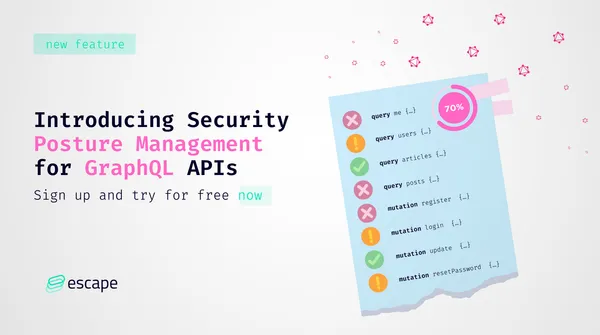
tl;dr The Escape Team is excited to announce the release of its latest feature, API Security Posture Management for GraphQL. This feature proposes a single API Catalog view to explore the security, integrity, and performance of all GraphQL operations in one place. See it for yourself in action With the rise of GraphQL as a popular API technology, it is essential to have an effective security solution in place, and Posture Management is designed to meet this need. Escape's API Posture Managemen

Antoine Carossio
Introducing OpenAPI.Security,
a free tool to quickly check the security of REST APIs

Introducing OpenAPI.Security, a free tool to quickly check the security of REST APIs

tl;dr We released OpenAPI.security, an online tool that performs a dozen of security tests on any given OpenAPI/Swagger-based API, with no signup or email required Our team at Escape is mainly focused on securing GraphQL APIs. For this, we developed a new approach called feedback-driven API exploration, basically inferring the right security test cases to run using the specification and a carefully crafted in-house graph traversal algorithm. - We published a more in-depth review of this algorit

Antoine Carossio
Escape is proud to be backed by Y Combinator!

Escape is proud to be backed by Y Combinator!

Escape is proud to announce that we are backed by Y Combinator, the world's most prestigious and well-known startup accelerator, joining the YC Winter 23 batch! Y Combinator, known for investing in and mentoring early-stage startups, has an impressive portfolio of successful companies such as Airbnb, Dropbox, and Stripe. A couple of months ago, we met Algolia co-founder Nicolas Dessaigne and discussed our vision that every company will soon have to release public APIs, yet developer teams lack

Antoine Carossio
Access Control and Data Segregation in multi-tenant GraphQL applications

Access Control and Data Segregation in multi-tenant GraphQL applications

If you have ever worked with GraphQL, you must know that ensuring proper data segregation and access control is implemented correctly is a nightmare, especially in multi-tenant environments. Access control and data segregation are critical aspects of any multi-tenant application where multiple customers or tenants share the same application instance. In such environments, ensuring that each tenant's data is isolated and segregated from other tenants' data is crucial. In GraphQL, this is even m

Antoine Carossio
Announcing GraphQL Armor support for GraphQL Yoga 2 - Bringing security by default to GraphQL

Announcing GraphQL Armor support for GraphQL Yoga 2 - Bringing security by default to GraphQL

We are utterly excited to introduce GraphQL Armor compatibility with Yoga 2. When the GraphQL Ecosystem encounters Security A few weeks ago, we released GraphQL Armor, an open-source middleware to add a security layer on top of GraphQL endpoints and mitigate common attacks. GraphQL Armor blocks abusive requests by putting reasonable and clever limits on Queries. It was designed as the go-to solution for building secure production GraphQL APIs. We also wanted it to be universal, but it was y

Antoine Carossio